
Satpreet Kahlon & Kristan Kennedy
Entering Satpreet Kahlon’s an imagined place (here and now), a multichannel audio-and-visual installation, felt like stepping into another world; it truly captures the appeal and power of immersive installation-based art. Throughout Portland Institute of Contemporary Art’s (PICA) gallery space, styrofoam structures are gathered—stacked, laid, balanced, and emerging from one another. This particular installation felt perfectly meant for this space.
Navigating the exhibition was intuitive, with every nook and cranny beckoning closer inspection. Asteroid-like sculptures may serve as resting spaces in the center while adding depth to the surrounding whole. Throughout the gallery, several sculptural elements play with materials familiar to Satpreet’s practice, such as wire, textiles, and video.
As you traverse the exhibition, you notice gemstones decorating the styrofoam, which serves as both a canvas and a tool for delineating the larger space. The twinkle of these stones shifts in the soft light, transitioning from bright white to soft tungsten and deep blue. Moving through the installation, a looped image of a lighthouse plays on a video player that seemed to be from the aughts—seeking and searching, much like I am, and much like we all are.
It felt particularly poignant to view this tender, personal body of work about familial displacement alongside my own child. Our present is connected to the past in so many ways. While that can feel like a platitude, it felt clearly true as I reflected on this exhibition and my own experience. How does trauma, displacement within our current imperialist capitalist society, lead to unfinished stories and beget unanswered questions? Before exiting, hidden, flickering battery-powered candles nestled in crevices of styrofoam throughout, tempted us to stay a little longer, their glow pulsed with a rhythm much like a heartbeat.
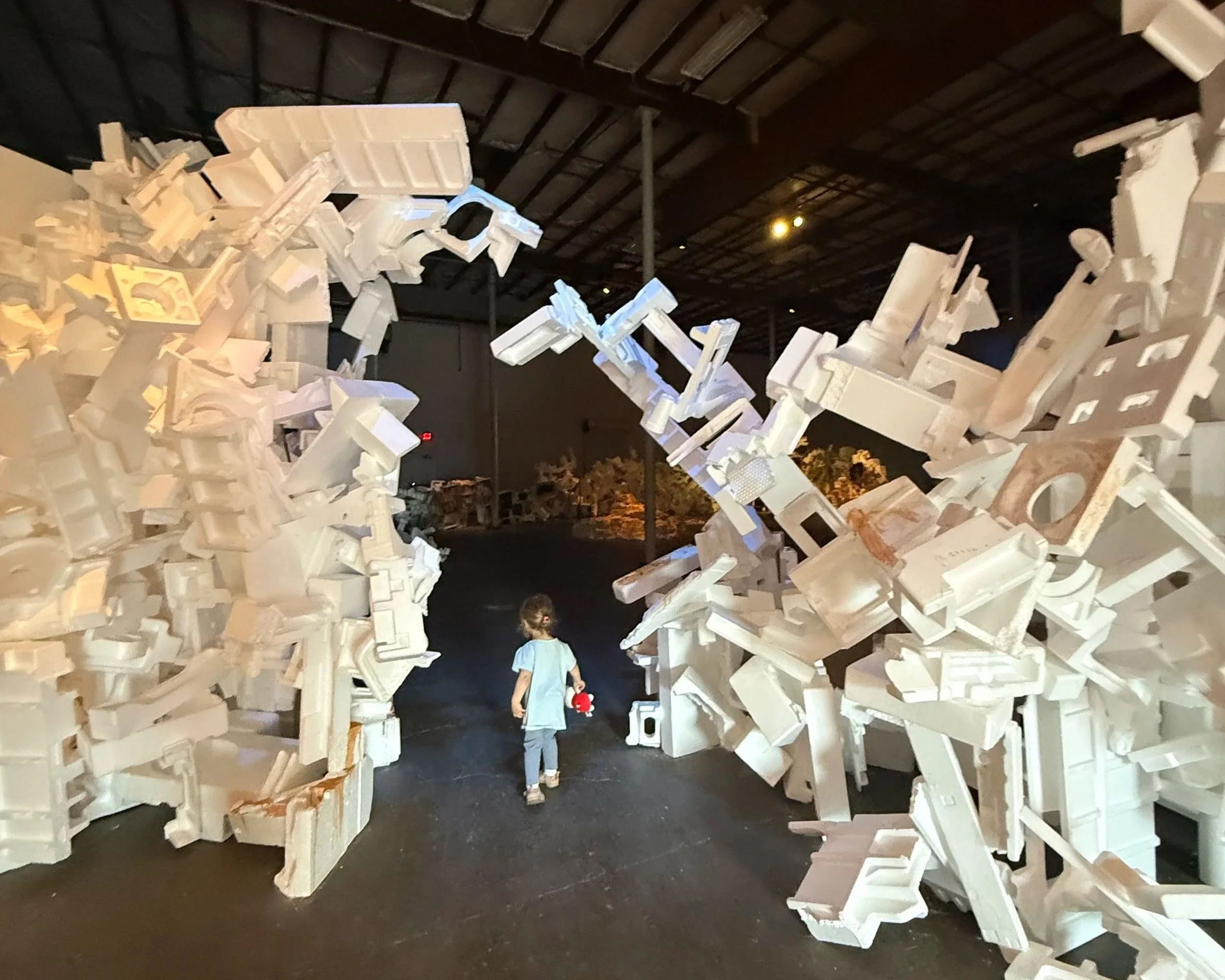
Satpreet Kahlon, an imagined place (here and now), photo by Ashley Gifford.
Ashley Gifford: Using PN7—a quasi-moon asteroid—as a site for exploring memory feels particularly potent. Could you unpack your reasoning behind choosing PN7, including its literal and metaphorical significance in relation to the an imagined place (here and now)?
Satpreet Kahlon: I've always been interested in fugitivity in my work, fugitivity as a form of survival. The scholar Dr. Katherine McKittrick discusses this extensively in her writing. That felt really pertinent to the way I think about my own cultural history.
It's just this void that I've encountered over and over in my life. Somewhere there was, like, a great-great-grandmother who's been lost to time, who I resembled, but I will never know her. In a way, I prefer that, even as hard as it is. If I had to choose between her living in some British archives as a subject or just being lost to time, including to me, I'd rather she be lost to time. Can a soul really rest when it's in an imperialist archive?
So when I heard about PN7 as this little, like, fugitive asteroid that no one knew about, that had been there observing the Earth for, like, 50 years, that was really interesting to me. It reflected all of these values and ideas that I'm kind of thinking about all the time. The fact that, despite all our technology and surveillance, this asteroid had evaded our notice immediately captured my imagination.
AG: Your practice is rooted in sculpture, but this installation fully immerses viewers through space, sound, and atmosphere. What was it like to engage in this level of world-building?
SK: It was super amazing to work on an exhibition of this scale. I love making installations. As someone with my lived experience, I feel like I have a history of a lot of really intense gaslighting in my childhood and sort of doubting myself as a human and a person. And I think I grew up, I used to write in my journal, over and over, I am alive, I am alive, I am alive, compulsively. The exhibition and the installation are like an externalization of that reminder. It's like a way for me to verify my feelings, thoughts, and lived experience. It's like when it's like physically embodied around you in a space, I feel this sense of reassurance of, oh, right. Like, all of my feelings are real. My experience is real. My take on my experience is real. And like my feelings are real. And so, for me, any installation, no matter how small, is like trying to create a world where I can see it. And so, working on this skill, as you can imagine, is so empowering.
I kept thinking like, “Why are they letting me do this?” Like a kid given full rein of something. Because, honestly, there was no proof of concept. I have never worked at this large a scale. I've never actually really worked with styrofoam, but Kristan just let me go for it.
And the scale was such a gift, because sometimes with my work, I want to create so many layers, but that sense of density can be lost or overwhelm a piece at a smaller scale. But because of the scale of PICA, I was able to explore everything and hide so much. I love little secrets in the work, and I feel like I could hide as much as I wanted without it feeling super crowded.
The whole installation, I hope, feels like it's like this breathing thing. I think, like all the elements, I was really interested in them feeling like they had room to breathe and that it was spacious. I wanted to create a sense of spaciousness and vastness that I think was really possible at this scale.
AG: Take us through some of the choices behind the installation—from sourcing materials to collaborating with the team.
SK: I knew I wanted to be involved with recycled materials. I had worked with Styrofoam a bit during the Recology residency in Seattle in 2021. And I really liked working with it, because there's something inherently alien about styrofoam—this idea of using all this material to house a really specific object. Creating a unique shape that immediately loses its meaning as soon as the item that was stored within the styrofoam is gone, and then it becomes an indecipherable puzzle. There's something alien about that.
Obviously, the waste part feels alien. It feels absolutely not of Earth. The people who are like, “Yeah, let's create all these toxic chemicals and toxic waste to create a packaging that is cheap for us to construct and cheap to ship, and who cares if it lasts forever and pollutes our waterways and soil,” Those are people who are super detached from their human bodies, their animal bodies, and the earth. So to me, that's alien. is already doing the work of the piece without anything added to it.
Sourcing styrofoam was difficult, but I reached out to the Ridwell team, and they were very helpful to work with. Within two days of my reaching out, we had a plan to get all the styrofoam we needed for the install and more.
Then, in terms of working with the team, I will say PICA’s team of preparators blew my mind. It was so interesting. I've never let people into my practice like that before, and it felt vulnerable and scary. But throughout the process, I had this huge team of rotating people to work with, and everyone brought a different skill to the work that made it what it was.
My favorite part was developing deeper working relationships with the core preparators who came almost every day throughout the three-week build, specifically John and the apprentices that we were able to hire, Lauren and Ellen.
To enter a space not knowing anyone, and within a week, feeling like I understand their unique working styles and that they understood and bought into my vision and trusted me - it was a really empowering and beautiful experience. It absolutely matters that they are all artists in their own right and are doing the thing that I have had to do for years and will probably have to do again: cobbling together gigs and being vulnerable to the whims of different institutions.
Every hour that they spent working with me is an hour they weren’t in their own spaces making their own work. That isn’t lost on me and is really humbling and emotional. It's something that I won't ever forget.
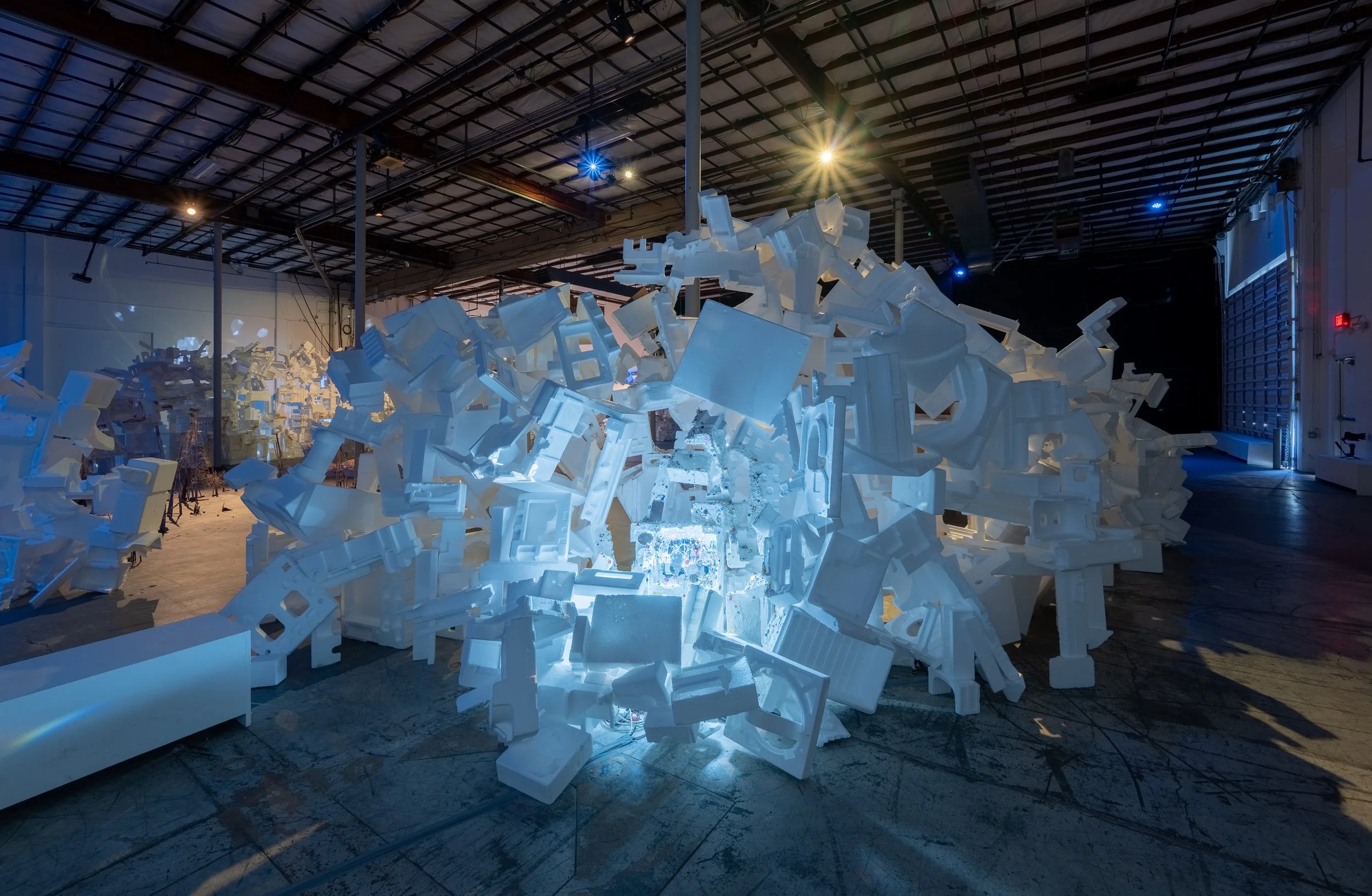
Satpreet Kahlon, an imagined place (here and now), image courtesy of PICA, photo by Mario Gallucci.
AG: Kristan, could you also speak to how this project developed and why you felt this work was important to bring to PICA?
KK: I first met Satpreet through an engagement at Washington State University before the pandemic. Over the years, we stayed in conversation around her work, and in 2022, she joined PICA’s Creative Exchange Lab Residency. In some ways, this project has been building across all of that time.
What I remember most clearly is that first encounter with her work—the tension between fragility and force. Her structures sit right on that edge, where something feels like it could give way but doesn’t. Around them, materials like plaster, pigment, cardboard, and images gather into forms that feel emotionally charged but unresolved, still thinking. When sound, reflected image, and video entered the work, it shifted how I understood moving through it. It became less about looking and more about staying—allowing the work to register differently over time, through the body.
The work engages with instability at both intimate and global scales—familial rupture, migration, inheritance—and at the same time keeps returning to a central question: how we continue. What we build, materially and conceptually, to stay oriented in that.
There’s something important, for me, in hearing a singular vision clearly—Satpreet’s—and then committing to making it real with the understanding that the process will expand beyond any one person. It becomes collective. It moves through many hands, bodies, and forms of attention, and that expansion is part of the work itself. What the viewer encounters isn’t a fixed statement but a constructed situation—something open enough to move through, sit with, and think alongside.
AG: What is your favorite moment in the installation?
SK: The sound for sure. It's something that surprised me. I've never constructed audio like this before. When I'm collecting videos, I use whatever audio is there. I don't usually record, coordinate, or have it all lined up in a loop like this. Molly, the light person at PICA, encouraged me to think about the loop because they have the tech to combine all the video and audio in a loop (more on the audio mentioned here). It’s like, we have this opportunity, think about it. And I felt really overwhelmed by that, but it ended up being like this really amazing challenge. And I'm really grateful that she encouraged me. The sound ended up being the most powerful part for me.
AG: What do you hope viewers take away from the an imagined place (here and now)?
SK: In a lot of my work, I play with this idea of the utopic state being one of, like, striving and failure. And I think we often think about like, oh, utopia's over there in the future. It's like far in the future, and it's far from me. What if it's here, and what if it's now? Just forget it. Don't say it's impossible. It couldn't happen. Just take that as a given. It is possible. Now, what is your place in that world? I think we all have a role to play. Not in a self-sacrificial way.
What is a thing you would actually enjoy? What is a space you would actually enjoy creating? What is a thing you would actually enjoy doing? In that utopic space, can you do it now? And could it save you? I think that work has saved me. I think we're made to feel so disempowered politically. I think it serves, who does that serve? I think questioning, who does that serve? And who does that leave behind? We all have the skill, like we all have something. I don't think I've ever met a person in my life who I feel like has nothing to contribute. I think a lot of us have lost touch with that for a lot of reasons, a lot of sociopolitical, global imperialist reasons. But we all have something to contribute. And I really want to encourage people to think about the inevitability of failure and do the thing anyway. Hopefully, this installation is the sort of thing that can transport you to a different time and space. And also, it's a warehouse full of styrofoam, right? It's all possible.
an imagined place (here and now), Satpreet Kahlon at Portland Institute for Contemporary Art (PICA) on view April 4 — May 23, 2026. Gallery Hours: Thursdays 2–8 p.m, Fridays 12–6 p.m., Saturdays 12–4 p.m.