Ruby Webb
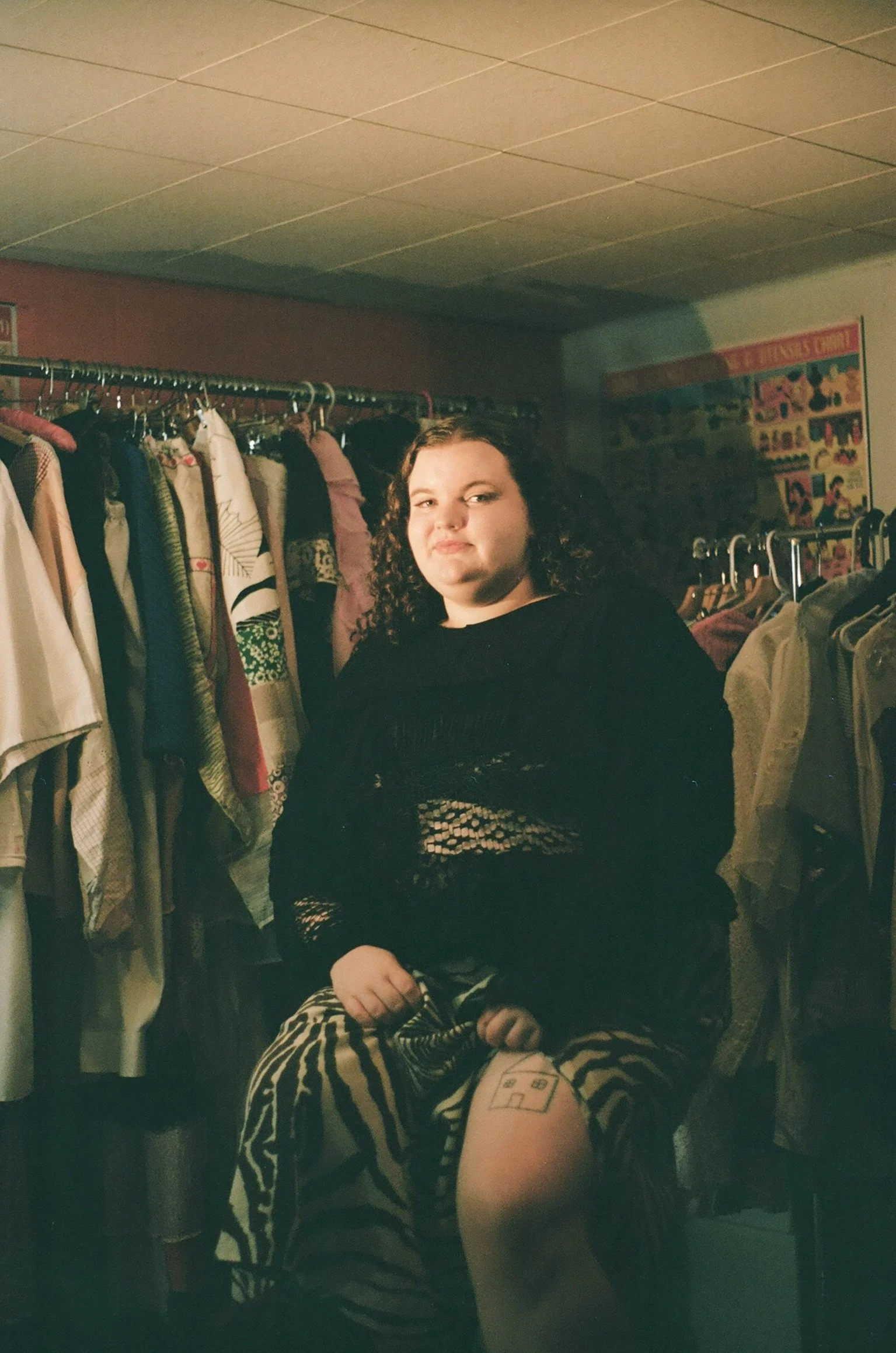
Ruby Webb is a force. She began sewing as a teenager, laying the foundation for a practice that has since evolved into her clothing line, Fruitful Interpretation of Time. Even at this nascent stage, her work reflects a confident, fully-formed vision—one rooted in instinct, imagination, and an unapologetic commitment to her craft.
Webb has cultivated a world her audience can step into. While her designs exist within a contemporary fashion landscape, the ideas driving them are distinctly her own. Recurring motifs—lace, bows, clocks, and references to home and pop culture (like these Snoopy bedsheets remade into sets). They are crafted from vintage fabrics and appear throughout her work as intentional symbols rather than decorative trends, forming a personal visual language. They act as conceptual anchors in her collections.
In conversations with Webb, while sharing art and culture media trends and parallels noticed in her work, she welcomes the dialogue; however, it’s clear that her ideas are entirely her own and exist fluidly within the zeitgeist. Her creative process is guided by curiosity, dream logic, and long-standing personal interests. The discussions drifted easily from aesthetics to shared fascinations—such as Yves Klein blue and the emotional resonance of color—before branching into broader reflections on fashion, culture, and the body.
Across several studio visits, we spoke at length about fatphobia and the language people use to talk about themselves. One observation she shared resonated. When we criticize our own bodies aloud, we aren’t only directing judgment inward; we’re also projecting it outward. To dismiss your body for its size or shape ultimately reinforces the dismissal of other bodies. Her point is simple but resonant: how does it feel to hear someone devalue their own body, and what does that communicate to those around them? These conversations get at a larger truth—that commentary on bodies, whether positive or negative, can sometimes do more harm than good.
As artists, the words we use and the images we create carry weight. The worlds we build through our work shape how people see themselves and each other. This awareness carries directly into Webb’s practice. Rather than positioning the body as something to be corrected, idealized, or explained, Fruitful Interpretation of Time allows it to exist. The result is work that feels radical—creating space for presence without judgment, and offering an alternative to the shame-laden narratives that so often dominate fashion and internet culture.
Beyond the studio, through her adventures in art and culture, whether in Portland, Seattle, or Los Angeles, this same open and genuine approach carries over into her social media presence. She does not gatekeep – she tags accounts and lets you, as a viewer, know where she is and what information she thinks is worth sharing. Her pop-ups and projects feel like natural extensions of her worldview: curious, thoughtful, and deeply connected to place. She treats fashion not as something remote or exclusive, but as a lived experience. This also translates into the images she creates – she often takes self-portraits or brings in her family to model with her.
Ruby engages with the world wholeheartedly, with a sincere appreciation for beauty, conversation, and life itself. It is truly inspiring to witness her perspective and dedication to her craft. That presence is intertwined into her work—and it’s what makes Fruitful Interpretation of Time feel less like a label and more like an invitation.
Ashley Gifford: Can you discuss artists that inspire you and why these particular artists are influential to you?
Ruby Web: Julio Torres and his mind—just wow. I’ve been a fan since Los Espookys in 2019. His obsession with giving objects and abstract ideas very specific stories and concepts is completely up my alley. His color choices and humor are on a similar wavelength to mine, making his work feel familiar and deeply enjoyable. Whether I’m listening to him speak or watching one of his shows, it’s always a comforting and inspiring experience.
I’m not exactly sure where I first encountered Iiu Susiraja’s work, but it was around six years ago. She’s my favorite photographer. Of course, I’m biased—we both work in self-portraiture—but I truly adore her work. Being fat and photographing fatness is extremely important to me, and plus-size representation in the art world is still far too rare. It’s uncommon to see bodies that look like mine in galleries or museums, so when I do, I become the biggest cheerleader. Susiraja’s photographs bring me so much joy: deadpan expressions paired with everyday objects arranged in unexpected ways. Her approach feels aligned with my own photographic process, and it’s incredibly refreshing to see that resonance reflected.
I don’t know if everyone would consider Anthony Bourdain an artist, but he’s someone I’ve admired since I was very young. My parents used to put on No Reservations, and I remember instantly being transported into other cultures and imagined experiences. As an only child, I spent a lot of time daydreaming, and his storytelling fed that curiosity. He’s a huge reason why I’m deeply interested in the world—people, food, art, and travel. He also influenced my love for solo travel in my early twenties. I’m motivated by connection and reciprocity; that energy fuels me when I’m sewing. In my studio, I have a bulletin board covered in notes and photo booth strips from friends I’ve met while traveling. When I feel stuck, I reread them and instantly feel that reciprocal appreciation and inspiration all over again.
Overall, I tend to feel most inspired by artists who are confident yet deeply curious.
AG: Tell me your favorite galleries in Portland and why.
RW: Rather than choosing just one, I’ll share a few of the most memorable exhibitions I’ve seen at Portland galleries over the past year or so.
Elbow Room — Rug Farm by Ricky Bearghost
I adore Ricky Bearghost and his creations immensely. Whenever I see his work, I leave with a smile and a renewed appreciation for his constant artistic drive. I get completely lost in his weavings—especially the beading—and am always amazed by how prolific he is.
after/time Gallery — chalecos protector by Orquidia Violeta
My mom and I stumbled upon this exhibition while running errands downtown and instantly fell in love with both Orquidia and her work. It was a phenomenal show. I felt the sentiment woven into every textile and appreciated each story she shared. The color choices and childlike qualities in her work really stayed with me. It was a rainy fall day, and feeling that level of vibrance left an impression I haven’t been able to shake.
Well Well — Born REMEMBERING by Garth Amundson & Pierre Gour
This was the most recent exhibition I attended, and I can’t stop thinking about it. One piece in particular—a large fan-like form made from photographic prints of tulips threaded together—completely mesmerized me. It hung on the wall in a way that required you to look up, which added to its impact. I’m especially drawn to work that evokes memory and nostalgia, and that’s exactly how I felt leaving this show. Both artists were also incredibly kind, which always deepens the experience.
AG: Favorite place to shoot lookbook photos?
RW: I love photographing in and around my house, though that’s admittedly predictable. In the spring, I’m drawn to quiet corners of Portland—especially cemeteries—where flowers are blooming. Another favorite location is my grandmother’s property in Montana, which I visit every July.
For the past five years, I’ve created a spring collection and then brought it to Montana to photograph throughout the Bitterroot Valley. More recently, I’ve started dressing my grandma in my designs and photographing us together. She’s a very sassy yet natural model, and I adore capturing her in my playful outfits. These images are incredibly special to me—I want to soak up every moment I have with her—and I plan to continue this series for a long time.
AG: You travel a lot for work. Is there a trip or memory that really stayed with you?
RW: For me, it’s usually the moments of kismet and connection that stand out. In May 2023, I traveled to New York City for a pop-up at Berriez, one of the shops I sell with—an amazing size-inclusive vintage and reworked store. After landing at JFK, I went straight to a bagel shop in Brooklyn. As I crossed the street, I looked to my right and saw Emma, the owner of Berriez, waving at me from her car. We hadn’t planned to see each other for two more days, so running into her immediately felt surreal.
I’ve met countless amazing people while traveling—probably a perk of being an extrovert. I love complimenting outfits or asking curious questions about what someone ordered. Often, those small moments turn into full conversations, and then the next time I’m in that city, we reconnect for a sweet little hangout.
AG: Can you describe your studio practice and how it fits into your daily life?
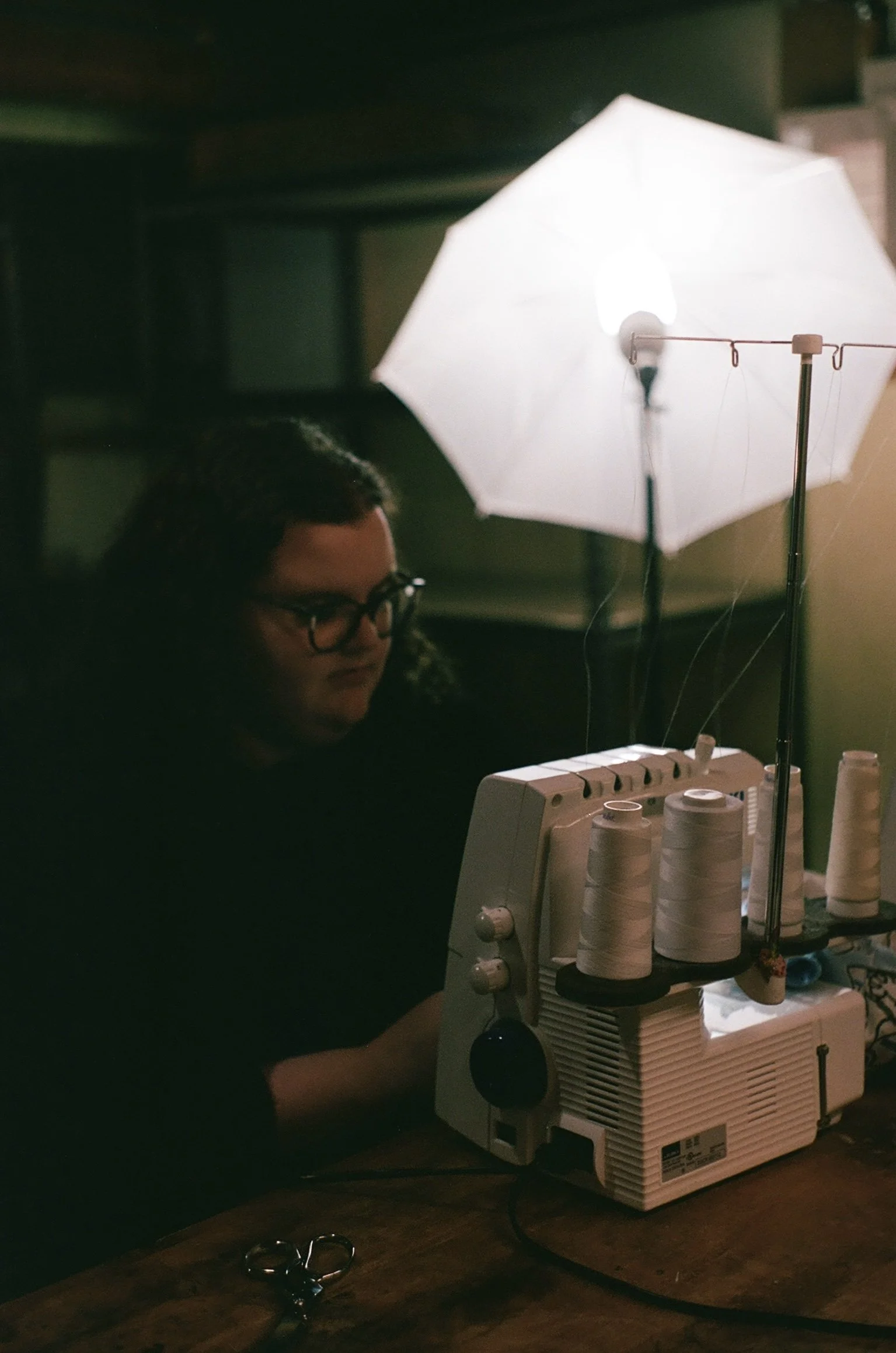
RW: On most weekdays, I spend about five to eight hours in my basement studio. I’m usually working on custom pieces, shop requests, or whatever ideas I feel drawn to at the moment, along with the occasional studio visit.
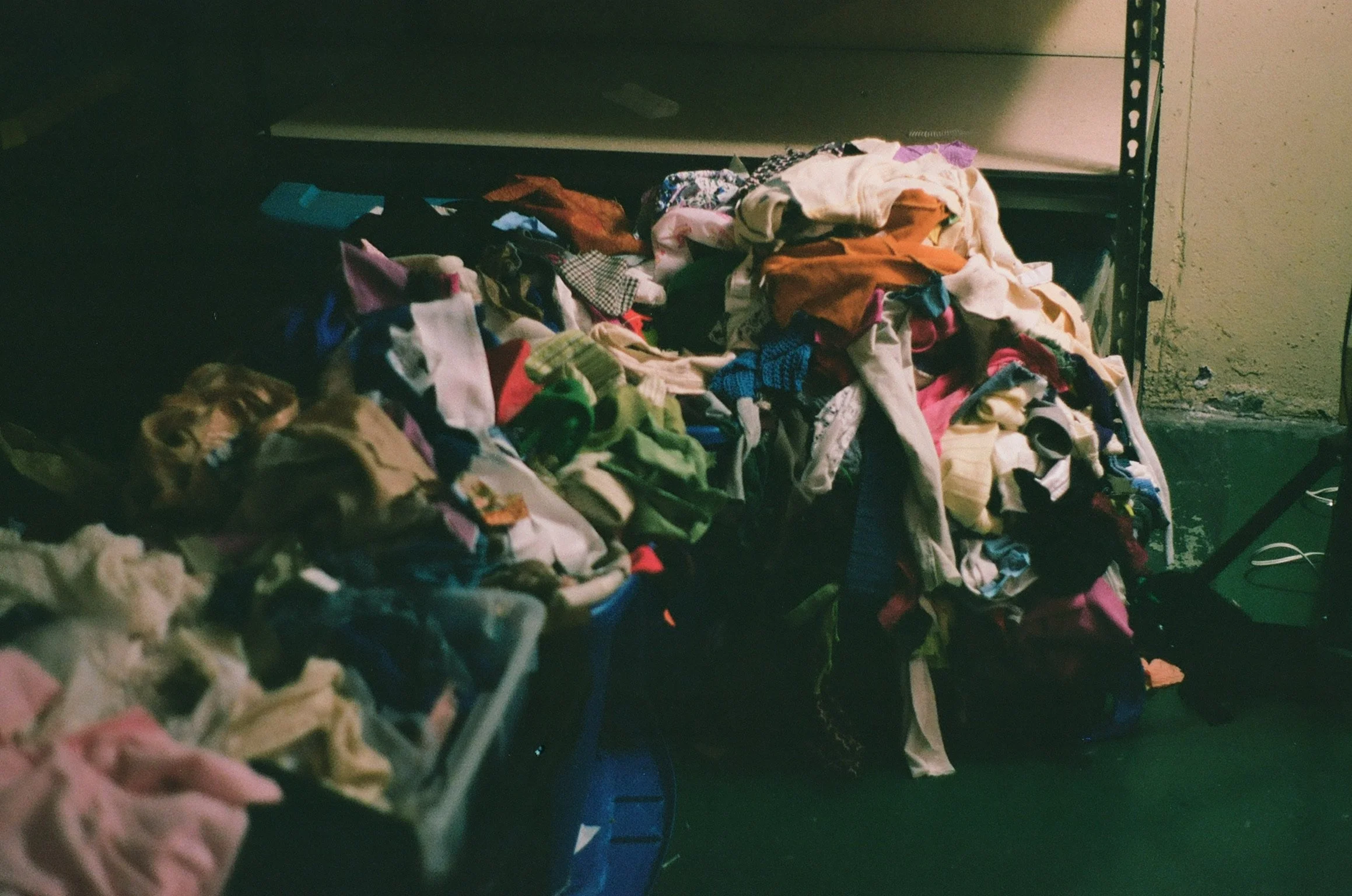
Thrift shops and estate sales are a weekly ritual for me. They’re time-consuming but fun, and lately I’ve been hunting for unique vintage ribbon for my bow button-up shirts. Even though I’m pretty decisive, it can take hours to dig through bins and racks. When something catches my eye, I instantly imagine multiple ways to turn it into a garment.
Most ideas live in my head, with the occasional messy sketch in my large studio notebook. I gather fabrics in bins, lay them out on my big old USPS sorting table, and begin cutting and arranging. Sewing while working flat—always looking down at the piece—is interesting because I don’t fully know how the garment will lie until it’s finished. That surprise is essential to my process and something I truly enjoy.
AG: What do you listen to while working, and what brings you joy outside of making art?
RW: I’m almost always listening to music. I mainly rotate between K‑pop (Seventeen and NCT are my favorites), funk, hip‑hop, and the jazz station KMHD. I also love discovering music from around the world. It’s cliché, but I genuinely wouldn’t be who I am without music. I’ve conditioned myself to turn on my speaker the moment I walk into my studio—it helps me settle into the rhythm of working almost instantly.
Outside the studio, walking has become a daily obsession. I usually take one or two walks a day, headphones on, wandering my neighborhood or seeking out parts of town with beautiful houses. During these walks, I reflect, plan, and absorb my surroundings. I’m very much a planner and like having my thoughts organized.
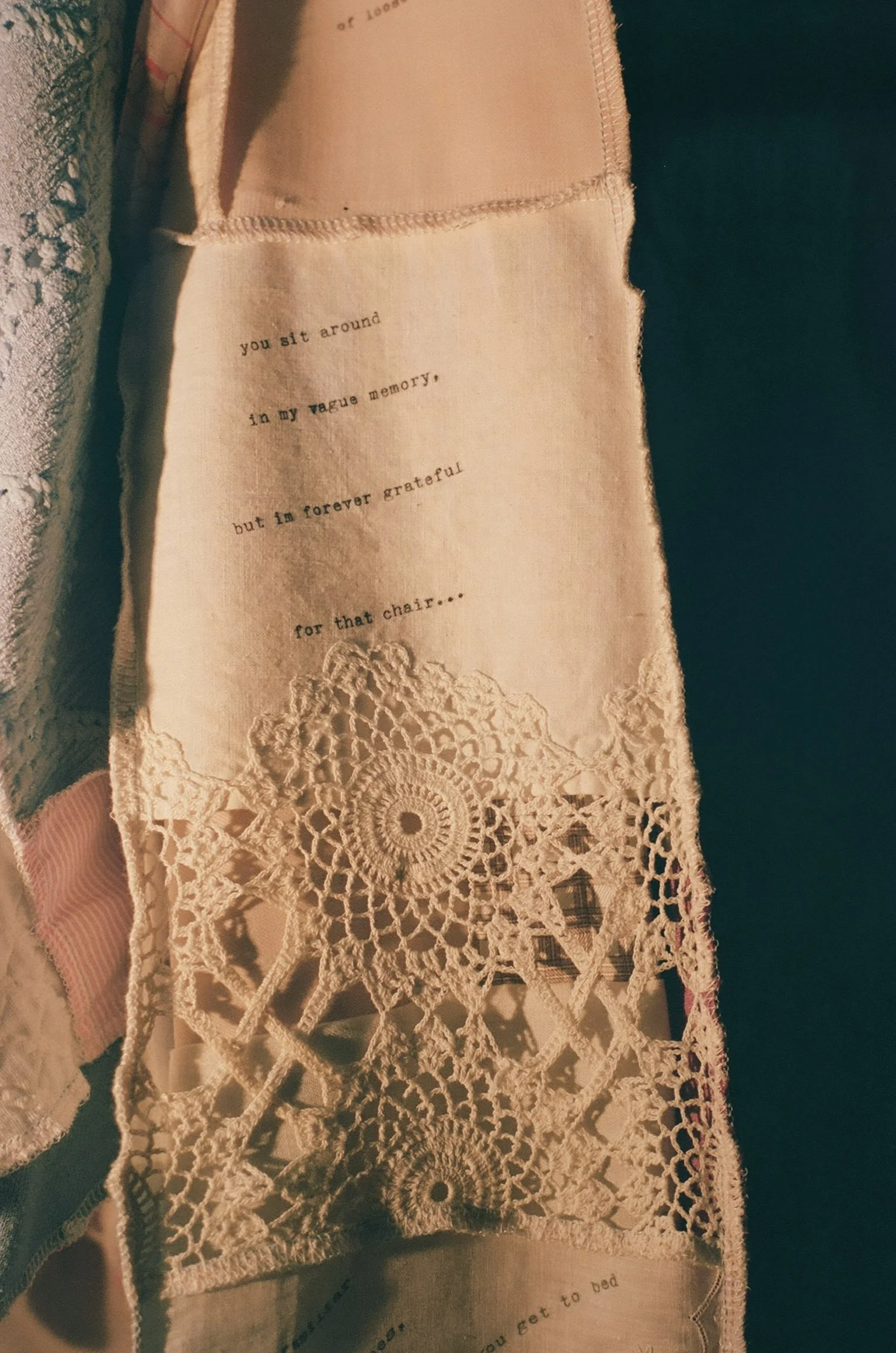
I also write haikus while walking, often inspired by things I see. I count syllables on my fingers—17 is ideal, but I’m flexible. My Notes app is full of seasonal haikus. Since last March, I’ve started typing them onto fabric with my typewriter. At the end of each season, I compile my favorites into a patchwork garment to honor that time.
AG: Top three colors?
RW: Cobalt blue and cornflower blue, neon orange, and silver chrome.
AG: Three to five words that describe your art?
RW: Playful textures of nostalgia.
AG: What’s your favorite season?
RW: My favorite season is spring—especially early spring, when the first sprouts begin to peek out. Crocuses are my favorite flower. Seeing them appear around trees feels like a signal of renewal and new beginnings. Honestly, I should make a shirt inspired by crocuses—and that’s usually how ideas come to me. They never really stop.